
- News
- City News
- lucknow News
- How burial of ‘Hazrat’ got Ganj its name
Trending
This story is from April 3, 2024
How burial of ‘Hazrat’ got Ganj its name
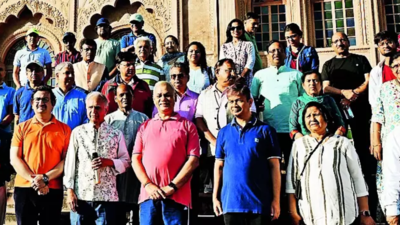
Heritage enthusiasts led by chief secretary Durga Shankar Mishra and principal secretary Mukesh Meshram with historian Ravi Bhatt in Hazratganj on Tuesday
This was one of the several intriguing stories narrated by noted city-based historian Ravi Bhatt during a heritage walk in the city on Tuesday.

At the centre of all stories was Hazratganj. Bhatt began with the iconic stretch and cluster of commercial, official, and residential structures around it and said it dates back to 1810 when Saadat Ali Khan laid a road in the heart of the city.
“The stretch gained prominence and commercial structures started to crop up here. By the time Amjad Ali Shah’s reign began, a flourishing market had come up and since then, Hazratganj has been the bustling nerve centre of the city,” said Bhatt.
“Amjad Ali Shah was a religious person and was often addressed as ‘Hazrat’, so when he was buried at the Sibtainabad Imambara, the area came to be known as Hazratganj,” Bhatt added.
Bhatt said the legacy of Hazratganj extended beyond the Nawabs. Near Janpath market in the area, the cold-blooded murder of Bahadur Shah Zafar’s sons at Delhi’s Khooni Darwaza was avenged. “Major William Hodson was shot here. It was then known as the Begum’s Palace (Begum Kothi). The palace was later razed in 1977 and Janpath came into existence.
After the first War of Independence, when the British did away with proxy rulers and feudal landlords and took direct control of the reign, the colonial legacy also got imprinted on Hazratganj. It was modelled after London’s Queen Street and named Queen’s Way.
Bhatt also narrated stories of how colonial rule defaced much of Lucknow’s heritage; one such monument was Sibtainabad Imambara. During the siege of the Residency, before the Meerut mutiny precipitated the First War of Independence in 1857, the British destroyed the walls of this edifice.
“Thereafter, it was used as a church until 1860 and the structure was categorized as a heritage monument,” he added.
End of Article
FOLLOW US ON SOCIAL MEDIA





Hot Picks
TOP TRENDING
Trending Stories
In City
Entire Website
- Diljit Dosanjh’s Dil-Luminati India Tour: Check dates, venue, how to book concert tickets online
- Hamster Kombat Daily Cipher Codes and Combo Cards for September 13, 2024: Unlock up to 1 million coins
- Narayana Murthy faces backlash for parenting remarks on social media; users say, "after working 72 hours a week, there’s barely time left to have babies…”
- Shreyas Iyer comes out to bat wearing sunglasses, falls for a duck in Duleep Trophy
- iPhone 16 will be available for Rs 54,900 on Apple website; here's how you can grab the deal
- iPhone 16 to go on pre-order today: Pre-booking details, time, sale date and more
- Vande Metro launch date, schedule: PM Modi to flag off Bhuj-Ahmedabad Vande Metro train; check timings, stoppages of new Indian Railways train
- Why around 40,000 TCS employees have received tax demand notices for Rs 50,000 to over Rs 1 lakh
- Bill meant to usurp Waqf land, JPC told
- Delhi to UP: IMD releases forecast and issues warnings across several states
- Preschools turn nursing homes, retirement age raised: China's demographic crisis explodes
- 'Osama's 'dead son' is alive, leading al-Qaida and has terrifying plans'
- 'I was molested in ambulance in which my husband was fighting for life'
- Despite debate win, Kamala Harris makes no dent in battleground states
- Assam CM reveals how his 'doubt' unearthed multi-crore trading scam
- 'CBI must dispel notion of being a caged parrot': SC during Kejriwal bail hearing
- Actor dies in his sleep. Why sudden heart attacks are killing Indians
- Jhumka Gira Re ...: American woman's Instagram post on India goes viral
- 'Vow to fight anti-national forces': Kejriwal after walking out of jail
- Vande Metro first look: Top 10 features of new train for common man

Popular Categories
Hot on the Web
Top Trends
Vande MetroAadhaar Card UpdateTech LayoffsArvind Kejriwal BailShannon SharpeAdani HinderburgUPSC Mains Admit CardKristina JoksimovicTCS Employee Tax NoticesWay Chatgpt can be your Study PartnerAir Taxi IndiaAyushman Bharat SchemeKolkata Doctor Rape CaseDonald TrumpShreyas IyerDiljit DosanjhLive Cricket Score
Trending Topics
Alia BhattMalaika Arora Father DeathArbaaz KhanNatasa StankovicMr Bachchan OTT ReleaseNational Parks In IndiaSelena GomezGOAT CollectionVikas Sethi DeathMalayalam ProducersIndia's Best Dancer 4Simi GarewalDilli BabuIndian National ParksLaung BenefitsVikas SethiApple iPhone 16SpaceXAadhar Card Update By Sept 14Wordle Answer
Living and entertainment
Latest News
7. Hindi becomes officialJulie Chen to miss Big Brother live eviction for first time, taps Jerry O'Connell to hostRaveena Tandon apologizes to fans for not photo snub in London: "It was not my intention to offend"Bonedi baris hope for a peaceful start to PujoPreschools turn nursing homes, retirement age raised: China's demographic crisis explodesTovino Thomas praises Prithviraj Sukumaran as director: "One of the brilliant directors I have ever worked with"Tragedy strikes at fundraiser: Mother of two dies after marshmallow-eating competitionMan shot near Delhi's Greater Kailash-I gym, gang war suspected8 animals that reproduce without mating'Cops stood as mute spectators': Protesting doctors write to President over RG Kar impasseFatal crash in Australia's Netherby claims life of ToddlerNASA to establish New Lunar Time Standard with Coordinated Lunar Time (LTC) initiativeDivya Bansal explores themes of human resilience, love and positive transformation in debut poetry bookWWE Superstar Cody Rhodes and his Wife Brandi Rhodes Share Special Messages on Their 11th AnniversaryAnupamaa: Anuj and Anu to go legal against Ankush and BarkhaTop 5 least private zodiac signsPerfect comfort foods for every zodiac signWWE Hall of Famer sheds light on major difference between Jacob Fatu and the rest of the Bloodline
Copyright © 2024 Bennett, Coleman & Co. Ltd. All rights reserved. For reprint rights: Times Syndication Service